There's a specific kind of worry that settles in when you're considering assisted living for a parent. It's not just about whether the place is clean or whether the food is good. It's something deeper than that.
It's the 2 AM thought: What if something happens and nobody finds them? What if they fall and call for help and nobody comes? What if the staff don't actually care?
That fear is completely legitimate. It's the right thing to think about — because the honest truth is that not all assisted living communities are equally safe, and the difference between a genuinely safe community and one that just looks safe on a brochure tour is something most families don't know how to measure.
This article gives you the tools to measure it. Not a polished checklist you'll forget the moment you leave — but a real, practical understanding of what safety in assisted living actually looks like, what questions cut through the marketing, and what answers tell you whether your loved one will genuinely be protected.
At Crown Point Assisted Living, we believe families who ask hard questions are doing exactly the right thing. So here are the hard questions — and honest answers.
COME SEE OUR SAFETY APPROACH FOR YOURSELF — SCHEDULE A TOUR
Why Safety in Assisted Living Is More Than a Checklist
Most families, when they think about assisted living safety, think about grab bars and emergency call buttons. Those things matter. But they're the floor, not the ceiling.
Real safety in assisted living comes from people, not equipment. It comes from a caregiver who notices that Mrs. Johnson is moving a little differently today and flags it before she falls. It comes from a medication routine that catches a missed dose before it compounds into a health crisis. It comes from a community small enough that every resident is genuinely known — so changes get noticed rather than lost.
The physical environment matters. Emergency systems matter. But the single most important safety factor in any assisted living community is staffing — how many people are caring for residents, how well they know them, and how consistently they show up.
Staff-to-resident ratios should be a priority question during facility tours, as these numbers directly affect both care quality and emergency response times. Everything else flows from this one number.
The Questions That Actually Tell You Something
These aren't the questions on a standard checklist. These are the ones that reveal what daily life actually looks like for a resident — and whether the answers you get are honest ones.
1. About Staffing — The Most Important Category
Q1. "What is your caregiver-to-resident ratio during the day? At night? On weekends?"
This is the single most important question you can ask. Get the exact numbers — not a range, not a reassuring description, but the actual ratio on a typical weekday and on a Sunday night when staffing is thinnest.
The industry average for assisted living runs somewhere between 1:8 and 1:15. Some large facilities stretch to 1:20 or worse on overnight shifts. At Crown Point Assisted Living, our 1:6 caregiver-to-resident ratio is maintained day and night — meaning your loved one always has consistent, attentive professional support when they need it.
In assisted living communities with adequate staffing, trained caregivers typically respond to emergency alerts within two to five minutes — with high-priority alerts often receiving a response within two minutes. The math on response time is simple: fewer staff caring for more residents means longer waits when something goes wrong.
Q2. "How long has your average caregiver been with you?"
Staff turnover is one of the most reliable indicators of a community's culture — and one of the most reliable predictors of resident safety outcomes. High staff turnover often results in inconsistent care for residents, which can be unsettling and unsafe. When caregivers cycle through frequently, residents are constantly dealing with strangers. Nobody knows their baseline. Nobody notices when something is off.
A community with long-tenured, stable staff is a community where residents are genuinely known. That familiarity is not a nicety — it is a safety mechanism.
Q3. "Who covers when a caregiver calls in sick?"
This question reveals whether adequate backup staffing exists or whether the community quietly operates short-staffed when coverage gaps arise. A thoughtful, specific answer — "we have a dedicated on-call pool" or "our administrator covers clinically when needed" — is a good sign. Vagueness or deflection is not.
Q4. "What specific training do your caregivers receive?"
Basic state certification is the minimum. Ask what's beyond it. States are increasingly moving toward stronger training and competency validation requirements — particularly in dementia care, infection control, behavioral health, and emergency response — with the shift away from simply completing training toward ensuring staff can actually demonstrate the required skills. A community that describes specific, ongoing training in these areas is one that takes safety seriously at a clinical level.
2. About Emergency Response
Q1. "Walk me through exactly what happens when a resident presses the call button."
Don't accept a general answer about response times. Ask for the specific process — who receives the alert, what they do first, what the escalation path looks like if a resident needs more than immediate assistance. The specificity of the answer tells you a lot about how practiced and ingrained the protocol actually is.
Modern assisted living communities employ alert technologies including wall-mounted call buttons, pendant necklaces, and wristbands — with wireless systems that can pinpoint the exact room location immediately notifying the care team on duty. Ask whether the system in use provides location identification, and ask when the emergency call systems were last tested.
Q2. "What is your protocol when a resident falls?"
Falls happen even in the best communities. What distinguishes safe communities isn't that falls never occur — it's what happens in the minutes and hours afterward. You want to hear: immediate assessment, family notification, documentation of the incident, physician or nurse consultation if warranted, and a care plan review to address what might have contributed to the fall.
A community that handles falls professionally and transparently is one that takes accountability seriously. One that minimizes, deflects, or can't describe a clear protocol is one that hasn't thought this through.
Q3. "How quickly do you contact families when something changes — and who makes that call?"
In a safe community, families hear from a person who actually knows their loved one — not a generic staff member reading from an incident form. Ask who specifically would call you, when they would call, and what kinds of changes trigger a family notification. Changes in behavior, appetite, mobility, and mood should all be on that list, not just falls and medical emergencies.
3. About the Physical Environment
Q1. "Can I see the bathrooms in the resident rooms?"
Bathrooms are where a disproportionate number of serious falls occur. They should have grab bars beside the toilet and in the shower, non-slip flooring, adequate lighting, and an emergency call system within reach of someone who has fallen. If these things aren't present, the physical environment has not been designed with safety in mind.
Walk the hallways too. Are they clear of clutter? Well-lit, including at night? Are there handrails on both sides of corridors? Is the flooring even, without transitions that create tripping hazards?
Q2. "How is the building secured — particularly for residents with memory conditions?"
For seniors with dementia, wandering is a genuine and serious safety risk. A safe community has secured entrances and exits that prevent elopement without creating a claustrophobic, locked-ward feel. Ask specifically how memory care residents' access to exits is managed, and whether there is outdoor space that residents can access safely without being able to wander beyond the property.
Q3. "What fire safety and emergency evacuation systems are in place?"
Sprinklers, smoke detectors, clearly marked exits, evacuation plans that account for residents with limited mobility — these should all be present and the staff should be able to describe them specifically. Ask when the last fire drill was conducted and whether residents with mobility limitations have individualized evacuation plans.
4. About Medication Safety
Q1. "How do you manage medications for residents?"
Medication errors are among the most common safety failures in senior care settings. Ask specifically: Who is responsible for medication management? How are doses tracked? What happens if a dose is missed or a resident refuses? How are pharmacy communication and prescription updates handled?
A clear, specific process — not a vague assurance that "we handle all of that" — is what you're listening for.
Q2. "What do you do if a resident's medication causes side effects that affect their safety?"
Some medications — blood pressure drugs, sleep aids, anxiety medications — significantly increase fall risk through dizziness, sedation, or sudden drops in blood pressure. A safety-conscious community monitors for these side effects, flags them to the resident's physician, and adjusts the care plan accordingly. Ask whether this monitoring happens proactively or only in response to an incident.
5. About Infection Control
Q. "What is your current approach to infection prevention?"
One of the main questions to ask when looking for an assisted living facility is what their infection rates are — if they're high, that's a major red flag, because seniors are at high risk of serious complications from infection. Ask about hand hygiene protocols, cleaning schedules, what happens when a resident is ill, and how the community handled outbreaks in the past. A community that is transparent about its infection control history is one you can trust. One that deflects the question is one worth being cautious about.
6. About Nutrition and Weight
Q."How do you monitor whether residents are eating and maintaining a healthy weight?"
Unexplained weight loss in a senior is a serious red flag — it can signal depression, illness, medication side effects, or inadequate nutrition. A safety-conscious community tracks resident weights regularly, flags changes to the care team, and adapts meals to individual needs and preferences.
Ask whether residents are assisted during meals if needed, and what happens if a resident consistently refuses to eat.
What to Watch for on the Tour — Beyond What You're Told
The tour itself tells you as much as the answers to your questions, if you know what you're looking at.
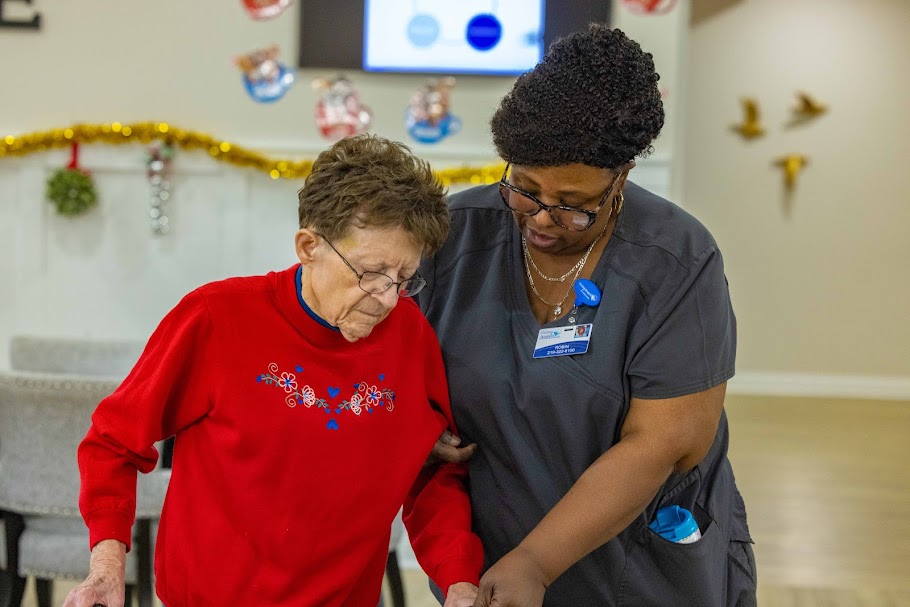
- Watch how staff interact with residents. Are interactions warm and individualized — staff calling residents by name, pausing to listen, demonstrating genuine familiarity? Or do they seem rushed, impersonal, or focused on tasks rather than people? Staff behavior during an ordinary tour moment is your best window into what daily life actually looks like.
- Watch the residents. Do they appear clean, well-groomed, and engaged? Do they seem comfortable in the space — relaxed, moving around, interacting with staff and each other? Residents who appear withdrawn, fearful, or disengaged in common areas during the day is a significant warning sign worth taking seriously.
- Pay attention to the smell. A persistent or overwhelming odor of urine, must, or chemicals is never just "a busy day." It reflects housekeeping standards, incontinence care quality, and the general attention to basic dignity that residents deserve. If a nursing home or assisted living facility is dirty or smells bad, it could be a red flag that a resident is at a higher risk of neglect.
- Notice whether staff seem happy. Staff who enjoy their work show it — in how they interact with residents and each other, in their body language, in whether they seem like they want to be there. High-morale staff are stable, low-turnover staff. Low-morale staff are often the first sign of management problems that eventually reach residents.
- Ask to visit at a different time. The tour you're given is the facility's best foot forward. Ask whether you can come back unannounced, or whether you can visit during a mealtime or evening. A community confident in its safety practices won't hesitate. One that resists unannounced visits is one worth thinking twice about.
The Green Flags — What a Genuinely Safe Community Looks Like
You'll recognize a safe community by several things that aren't on any checklist.
- Staff who know every resident by name. Not the residents in their assigned wing — every resident. In a small community, this is possible. In a large facility, it isn't.
- Transparent, specific answers to every question. Safe communities don't become defensive when families ask hard questions. They welcome scrutiny because they have nothing to hide and are proud of what they've built.
- A care team that includes families. Safety isn't just about what happens when you're not there — it's about whether you're genuinely informed and involved. A community that treats families as partners in care rather than occasional visitors is one that understands what real accountability looks like.
- Consistent staff who know your loved one's baseline. This is the factor that makes the most difference in catching problems early. The caregiver who knows that your mother never refuses breakfast, so her untouched plate this morning means something — that is the most important safety feature any community can offer, and it only exists where ratios are low and staff are stable.
- An environment that feels calm. Not quiet, not sterile — calm. A community where residents move around, conversations are happening, staff are engaged, and nobody looks rushed or overwhelmed. Calm comes from adequate staffing and good management. You can feel it the moment you walk in the door.
The Red Flags — What to Walk Away From
Some things you observe or hear should stop you cold.
- Vague or defensive answers about staffing ratios. If the number is good, they'll tell you. If they can't — or won't — that tells you something.
- Caregiver turnover described as "normal" or not tracked. Consistency in staffing is critical for quality care — frequent staff changes can disrupt continuity of care and may indicate dissatisfaction among employees, which could ultimately affect your loved one's experience.
- Residents who look unkempt, fearful, or disengaged. Trust what you observe with your own eyes.
- An inability to describe emergency protocols specifically. Every staff member in a safe community knows what to do in an emergency and can describe it without hesitation.
- Restrictions on unannounced visits. A community with nothing to hide welcomes them.
- Excessive promises without evidence. If a facility promises extraordinary services without providing evidence or details, verify their claims by speaking to current residents and families, reading reviews, or observing the community in action during unannounced visits.
- A tour that never takes you to resident spaces. You should see a resident room — ideally one similar to what your loved one would have — and the bathrooms. If the tour stays in common areas and administrative spaces, ask why.
How Crown Point Answers These Questions
We'll be direct: not every assisted living community can answer all of the questions in this article with confidence. That's exactly why these questions matter.
At Crown Point Assisted Living, here is how we answer them:
Our caregiver-to-resident ratio is 1:6 — day, night, and weekends. Not a range. Not a goal. The actual ratio your loved one will experience every single day.
Our team is small, stable, and consistent. Caregivers work with the same residents every shift. They know each person's baseline — how they move, how they eat, how they talk — so changes get noticed early, not after something goes wrong.
Our environment was designed with safety in mind from the ground up. Private rooms with proper bathroom safety features. Clear, well-lit hallways. No stairs to navigate in the night. Secured entrances for memory care residents. A home-like physical environment that is genuinely safer than most homes.
Our memory care program addresses wandering, behavioral changes, and the specific safety needs of residents with Alzheimer's and dementia with trained staff and a secured, calm environment built around their needs.
We welcome hard questions. We welcome unannounced visits. We welcome families who want to understand exactly what safety looks like here — because we're proud of the answer.
Frequently Asked Questions
1. How do I know if an assisted living community is actually safe?
Beyond the physical environment — grab bars, emergency call systems, secure entrances — the most important indicators of safety are staffing ratio, staff consistency and tenure, transparency in answering hard questions, and what you observe on an unannounced or off-hours visit. A genuinely safe community welcomes scrutiny and can answer specific questions about staffing, emergency protocols, medication management, and incident response without hesitation or deflection.
2. What is a safe caregiver-to-resident ratio in assisted living?
In assisted living communities with adequate staffing, trained caregivers typically respond to emergency alerts within two to five minutes. The staffing ratio that makes this response time possible varies, but lower ratios consistently produce better outcomes. Ask for the exact ratio on a typical weekday shift and on an overnight weekend shift — these numbers often differ significantly and the overnight/weekend number is the one that matters most when emergencies are most likely to go unwitnessed.
3. What are the biggest red flags when touring an assisted living community?
High staff turnover or inability to state average staff tenure. Vague or defensive answers about staffing ratios. Residents who appear unkempt, fearful, or disengaged. Persistent unpleasant odors. A tour that avoids resident rooms and bathrooms. Restrictions on unannounced visits. Inability to describe emergency protocols specifically. Any of these warrant serious caution.
4. How quickly should assisted living staff respond to an emergency call?
In communities with adequate staffing, caregivers typically respond to emergency alerts within two to five minutes, with high-priority alerts often receiving a response within two minutes. Ask for the community's specific response time standard and ask how it is monitored and enforced.
5. What questions should I ask about medication safety in assisted living?
Ask who is responsible for medication management, how doses are tracked and documented, what happens when a dose is missed or refused, how pharmacy communication is handled, and how the community monitors for medication side effects that increase fall risk. A specific, confident answer to all of these is a strong green flag.
6. How do small assisted living homes compare to large facilities on safety?
Small communities with lower staff-to-resident ratios and more stable, consistent staffing generally produce better safety outcomes. Staff who work with a smaller, consistent group of residents develop the deep familiarity with each person's baseline that allows them to catch health changes early. Research links higher rates of neglect and preventable incidents to understaffed, high-turnover facilities — problems that are more common in larger, for-profit institutional settings. Read more in our article on small assisted living homes vs. large facilities.
7. What should I look for in how staff treat residents during a tour?
Warmth and genuine familiarity — staff calling residents by name, pausing in tasks to engage, demonstrating that they know each person as an individual. You're looking for interactions that feel like they happen between people who genuinely know and like each other, not service transactions between strangers. Staff behavior during a tour is your best window into the daily culture of a community.
8. Is it okay to visit an assisted living community unannounced?
Yes — and a community that welcomes this is one you can trust. A quality community is as good on a random Tuesday afternoon as it is on a scheduled tour. If a community resists unannounced visits or makes it difficult to see the facility outside of a formal tour, that resistance is itself a red flag worth taking seriously.
9. How do I know if staff truly know my loved one after they move in?
Ask the caregiver who will work with your loved one most directly to describe them — their preferences, their routines, what they enjoy, what makes them anxious. If the answer is specific and confident, the relationship is real. If it's vague and general, they don't know your loved one yet. This question is worth asking again three weeks after move-in.
10. What is Crown Point Assisted Living's approach to resident safety?
At Crown Point, our safety approach starts with our 1:6 caregiver-to-resident ratio — maintained day and night — and our commitment to staffing consistency that ensures every resident is genuinely known by the people caring for them. Our home-like physical environment was designed with fall prevention and mobility safety in mind.