When families start searching for assisted living, they quickly discover that not all communities are built the same way. Some are large, campus-style facilities with hundreds of residents, multiple wings, professional activity directors, and extensive amenity lists. Others are small, home-like communities where a handful of caregivers know every resident by name and dinner feels less like a dining hall and more like sitting down with family.
Both models exist for a reason. Both can provide good care. But for a growing number of families — and for the research backing them up — the differences between these two settings matter enormously when it comes to daily quality of life, safety, emotional well-being, and whether your loved one actually feels at home.
This guide breaks down the real differences between small assisted living homes and large assisted living facilities — honestly, without pushing you toward either — so your family can make the decision that fits your loved one's specific needs, personality, and situation.
What Is a Small Assisted Living Home?
A small assisted living home — sometimes called a residential assisted living home, boutique assisted living, or group home — typically houses anywhere from 6 to 20 residents in a converted residential property or purpose-built small-scale facility.
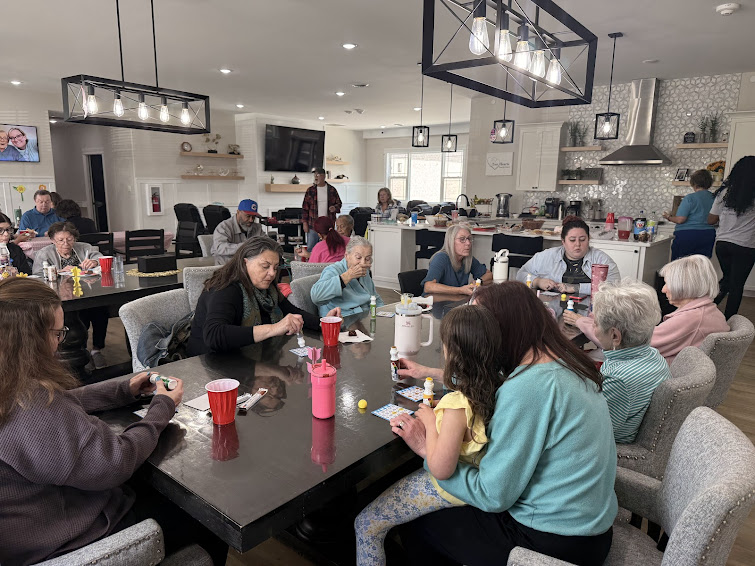
The defining characteristic isn't just size. It's the feel. Small homes are designed to replicate the experience of living in a real home — shared common spaces, home-cooked meals, a consistent set of caregivers, and daily rhythms that center around the residents rather than an institutional schedule.
At Crown Point Assisted Living, for example, residents live in a home-like setting with private rooms, familiar daily routines, and a 1:6 caregiver-to-resident ratio — meaning your loved one is never one face among hundreds. They are known. By name. By preference. By personality.
What Is a Large Assisted Living Facility?
Large assisted living facilities typically house 50 to 300+ residents across multiple floors or wings. They're often operated by regional or national chains and tend to offer a broader range of services — multiple dining options, on-site therapy, fitness centers, scheduled transportation, and structured activities programs.
The appeal is understandable: more amenities, more staff specialists, more services under one roof, and a recognizable brand name that many families find reassuring.
But size brings trade-offs. And those trade-offs affect the daily experience of your loved one in ways that an amenity list won't show you.
The 8 Key Differences — Side by Side
1. Staff-to-Resident Ratio
This is the most important number in senior care — and the one most families don't ask about until it's too late.
In large facilities, staffing ratios during the day often run 1 caregiver to every 12–20 residents. Nighttime ratios can stretch to 1:30 or higher. In a community of 150 residents with 8 overnight staff, basic math tells you how quickly things can go unnoticed.
Small assisted living homes maintain significantly lower ratios. At Crown Point Assisted Living, our caregivers work at a 1:6 ratio — well above the industry average — during both day and night shifts. That means faster response times, more personal attention, and a level of daily awareness about each resident's health, mood, and changes that is simply not
possible at scale.
What this looks like in practice: In a small home, a caregiver notices that Margaret didn't finish her breakfast and seemed quieter than usual this morning. In a large facility, that same observation might not get made at all.
2. Personalization of Care
Assisted living care plans are only as good as the people executing them. In a large facility, care plans exist on paper — but the rotating staff who actually implement them may not know your loved one well enough to notice when something is off.
In a small home, caregivers work consistently with the same small group of residents. They know who takes their coffee black. Who gets anxious before doctor appointments. Who lights up when a specific song comes on. Who needs five extra minutes in the morning to feel like themselves.
That depth of knowledge doesn't come from a care plan document. It comes from genuine relationship — and genuine relationship is only possible when the ratio of people to caregivers is small enough for relationships to actually form.
3. Environment and Atmosphere
Walk into a large assisted living facility and you're likely to encounter wide hallways, institutional signage, a front desk, a security check-in, and common areas that feel more like a hotel lobby than someone's home.
Walk into a small assisted living home and the atmosphere is categorically different. There's a kitchen where meals are actually cooked. There's a living room where residents genuinely gather, not because it's "activity time" but because it's where people are. There are familiar faces at every turn — not strangers passing in a corridor.
For seniors — especially those adjusting to a major life transition or living with early memory challenges — this distinction is not cosmetic. Environment directly affects anxiety, social engagement, sleep quality, and emotional well-being. A space that feels like a home helps people feel safe. A space that feels like an institution can amplify disorientation and withdrawal.
4. Meals and Nutrition
In large facilities, meals are typically prepared in commercial kitchens for dozens or hundreds of residents at once. Even the best institutional dining programs struggle to replicate what home cooking actually feels like — the smell, the flexibility, the sense that someone made this specifically for you.
Small assisted living homes prepare meals in real kitchens for a small number of residents. Dietary preferences, health needs, and personal tastes can genuinely be accommodated. Residents can smell lunch being prepared from the common room. Mealtimes become a social anchor — something to look forward to — rather than a cafeteria-style transaction.
At Crown Point Assisted Living, home-cooked meals are one of our core commitments. Fresh, nutritious food prepared daily with seasonal ingredients — and the flexibility to honor individual preferences, dietary needs, and the simple dignity of having someone cook for you.
5. Consistency of Caregivers
One of the most common complaints families share about large facilities is caregiver turnover and inconsistency. When staffing is stretched thin across a large community, agencies and part-time workers fill gaps. Residents regularly encounter unfamiliar faces providing the most intimate kinds of care — bathing, dressing, mobility assistance.
For seniors — particularly those with cognitive changes or anxiety — consistent caregivers are not a preference. They are a clinical need. Trust is built through repetition and familiarity. When that consistency is disrupted constantly, residents can become anxious, uncooperative, or withdrawn — and families often don't understand why.
Small assisted living homes, by nature of their size, maintain a smaller, more consistent caregiving team. At Crown Point Assisted Living, our caregivers aren't assigned to a wing — they're part of a household. Residents know them. Families know them. And that familiarity is what makes genuine care possible.
6. Social Life and Community
Here's where large facilities genuinely shine — at least on paper. More residents means more potential social connections. Larger activity calendars. Organized outings. Special events. For some personalities — extroverted seniors who thrive on variety and stimulation — a larger community can be genuinely energizing.
But the reality of social life in a large facility is more complicated than the activity calendar suggests. Large communities can actually be deeply isolating for seniors who struggle with mobility, hearing loss, or cognitive changes. A dining room with 80 people can feel overwhelming. A busy common area with strangers can feel lonely in a way that a quiet room with familiar faces does not.
In small assisted living homes, community is organic rather than programmed. Residents develop real relationships with the people they share meals with every day. Caregivers become companions, not just service providers. The intimacy of the environment encourages genuine connection in a way that structured social programming often cannot.
7. Family Experience and Communication
In large facilities, families often describe a sense of distance — difficulty reaching the right person, updates that feel generic, a feeling that their loved one is one of many rather than someone known and valued.
In small assisted living homes, families typically have direct access to the same small team of caregivers their loved one interacts with daily. Updates are personal. Concerns are addressed by people who know your loved one — not a general staff member reading from a chart.
At Crown Point Assisted Living, we treat families as partners in care. When something changes with a resident's health, mood, or routine, the right person calls — and that person actually knows what they're talking about, because they were there.
8. Cost
This is where many families expect large facilities to win — and the answer is more nuanced than they expect.
Large facilities often have higher base rates driven by overhead costs: large staffs, commercial kitchen operations, activity departments, administrative teams, and facility maintenance. Their amenity lists are longer, but those amenities often come at an additional fee beyond the base rate.
Small assisted living homes typically have more predictable, all-inclusive pricing — lower overhead, fewer administrative layers, and a cost structure that reflects actual care rather than facility upkeep. In many cases, the total cost of a small home is comparable to or even lower than a large facility when all fees are accounted for.
The more important question isn't which model costs less — it's which model delivers more actual value for the monthly investment.
Who Does Each Model Serve Best?
Neither small homes nor large facilities are universally better. They serve different needs, personalities, and situations.
A small assisted living home tends to be a better fit when:
- Your loved one values familiarity, routine, and a home-like atmosphere over amenities
- They have anxiety, memory challenges, or cognitive changes that make large, busy environments overwhelming
- They thrive in close, consistent relationships rather than large social settings
- Your family wants direct, personal communication with caregivers
- You're looking for a community where your loved one will be genuinely known — not just cared for
A large assisted living facility tends to be a better fit when:
- Your loved one is highly social and thrives on variety, stimulation, and a larger peer community
- They have specific medical or specialty service needs that require on-site clinical resources
- They're transitioning from a larger home and prefer a broader range of amenity choices
- They specifically request or are excited by the features a larger campus offers
The honest question to ask yourself: What kind of environment has made my loved one happiest throughout their life? The answer to that question tells you more than any amenity comparison ever will.
The Trend Is Clear — And It Matters
The assisted living industry is watching a decisive shift. The incoming generation of seniors is not simply seeking housing — they are selecting a lifestyle, and communities designed for this moment increasingly reflect hospitality-driven environments rather than institutional models.
Baby boomers entering assisted living are not looking for the communities their parents moved into. They want to feel like themselves — independent, connected, respected, and living in a space that feels like a home. The small assisted living model isn't a compromise. For the right person, it's the superior choice.
At the same time, the data on what actually produces better outcomes in senior care is telling. Lower staff-to-resident ratios consistently correlate with better safety outcomes, faster health change detection, and higher resident satisfaction. The intimacy of a small community is not just emotionally appealing — it is clinically meaningful.
Questions to Ask on Every Tour — Large or Small
Whether you're visiting a large facility or a small home, these questions will help you see past the marketing and understand what daily life actually looks like:
1. About staffing:
- What is your caregiver-to-resident ratio during the day? At night? On weekends?
- How often do residents see the same caregivers versus rotating staff?
- What is your average staff tenure?
2. About care:
- How are care plans developed, and how often are they updated?
- Who do I call if something changes with my loved one's health or mood?
- How quickly do you notify families when something changes?
3. About daily life:
- Can I see where meals are prepared? Can I try the food?
- What does a typical Tuesday look like for a resident at your level of care?
- What happens if my loved one doesn't want to participate in group activities?
4. About the community:
- How many residents currently live here?
- What is your current occupancy, and what is the waitlist situation?
- Can I speak with a current family member about their experience?
The answers to these questions — not the brochure — will tell you where your loved one will truly thrive.
Why Crown Point Assisted Living Is Built Around This Model
Crown Point Assisted Living was designed from the ground up around the small, home-like model — because we believe it delivers genuinely better outcomes for the seniors we serve.
Our community offers:
- A 1:6 caregiver-to-resident ratio — one of the strongest in Northwest Indiana
- Private rooms in a warm, residential setting
- Home-cooked meals prepared daily with individual dietary needs in mind
- A consistent, familiar caregiving team that residents and families know by name
- Personalized care plans that go beyond paperwork
- Memory care, respite care, and adult day care for families at every stage of the journey
- Activities designed around what residents actually enjoy — not a one-size calendar
We're not the right fit for every family. But for families who want their loved one to be genuinely known, genuinely cared for, and genuinely at home — we'd love to show you what that looks like in person.
Frequently Asked Questions
1. What is the difference between a small assisted living home and a large assisted living facility?
The primary differences are size, staff-to-resident ratio, atmosphere, and approach to care. Small homes typically house 6–20 residents in a residential-style setting with consistent caregiving teams and home-cooked meals. Large facilities house 50–300+ residents in a campus-style setting with more amenities but higher staff-to-resident ratios and less personalized daily attention.
2. Are small assisted living homes safe?
Yes — and in many respects, the research supports better safety outcomes in smaller settings. Lower caregiver-to-resident ratios mean faster response times, more consistent health monitoring, and a greater likelihood that subtle changes in a resident's condition are noticed and addressed early. Safety in senior care is directly tied to how well staff know and monitor each individual resident.
3. Are small assisted living homes cheaper than large facilities?
Not always, but often comparably priced or less expensive when all fees are factored in. Large facilities may advertise lower base rates but charge separately for care levels, activities, and amenities that small homes typically include in an all-inclusive rate. The best approach is to compare total monthly costs — not just the advertised starting price.
4. Is a small assisted living home good for someone with dementia?
Small homes are often specifically recommended for seniors with dementia or Alzheimer's. Consistent caregivers, familiar environments, quiet routines, and low stimulation are all clinically beneficial for cognitive health. Large, busy environments can increase confusion and anxiety in residents with memory conditions. Learn more about how we approach memory care at Crown Point Assisted Living.
5. What are the disadvantages of a small assisted living home?
The main trade-offs are a smaller social community, fewer on-site specialty services (such as on-site physical therapy or multiple dining venues), and less variety in daily programming. For highly extroverted seniors or those with complex medical needs requiring on-site clinical resources, a larger facility may be a better fit.
6. How do I choose between a small home and a large facility?
Start by thinking honestly about your loved one's personality, social preferences, and care needs. Then visit both types of communities — ideally at mealtimes or during regular daily hours rather than during a formal tour. Pay attention to how staff interact with residents, how residents seem emotionally, and how the environment feels. The community that genuinely feels like home to your loved one is almost always the right answer.
7. What does residential assisted living mean?
Residential assisted living refers to small-scale assisted living provided in a home-like residential setting, as opposed to a large, institutional facility. The focus is on maintaining the feel and rhythms of home while providing professional daily care. Crown Point Assisted Living is built around the residential assisted living model.
8. How many residents does Crown Point Assisted Living have?
Crown Point Assisted Living operates as a small, home-like community — not a large institutional facility. Our intentionally small size allows us to maintain a 1:6 caregiver-to-resident ratio and provide the personalized attention that our residents deserve.